WULOLIFE
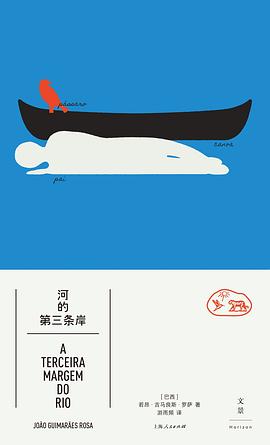
*The Third Bank of the River* by [Brazil] João Guimarães Rosa Publisher: Shanghai People's Publishing House
*The Third Bank of the River* by [Brazil] João Guimarães Rosa Publisher: Shanghai People's Publishing House
Couldn't load pickup availability
Description
Content Description · · · · · ·
☆ Featuring selected masterpieces from Rosa's peak period, meticulously translated, with versions funded by the Brazilian National Library and the Rosa Institute
☆ Yu Hua's beloved masterpiece, listed as one of his "Ten Short Stories That Influenced My Life," repeatedly recommended to readers and students
☆ Influenced renowned writers such as Yan Lianke, Ge Fei, Su Tong, and Xu Zechen; Cao Wenxuan included the titular short story in his "Great Chinese Language" extracurricular reading series; a classic awaited by the Chinese-speaking world for 30 years
☆ The man who never comes ashore, chasing the wildness of the river all his life, a masterpiece that exemplifies "one short story encapsulating a hundred years of life"
☆ The father who left and never returned × The girl who foretells the future × The revolutionary who went mad in a treetop × The bloodthirsty hunter obsessed with wild leopards × The bandit brothers who loved and killed each other... A fantastical world in the heart of Brazil, the explosive sound of magical realism
☆ Rosa is widely regarded as one of the greatest Latin American writers of the 20th century; Vargas Llosa praised him as someone who "should have won the Nobel Prize in Literature"
☆ A genius writer proficient in over 20 languages, who thoroughly broke free from "drowsy clichés," a master of linguistic adventure who transforms every ordinary moment into the miracle of the sun's rebirth
————————
Almost all of Rosa's novels are set in the hinterlands of northeastern Brazil, a region filled with mountains, river valleys, deep ravines, swamps, and wilderness, with ever-changing and mysterious terrain. A father who never comes ashore, a Quixotic old man seeking revenge, a little girl with miraculous prophetic abilities, a madman who climbs to the top of a palm tree and incites violent revolution, bandit brothers, and bloodthirsty indigenous people who merge with wild leopards... The characters not only possess distinct hinterland characteristics, but their fates are also full of magic and absurdity. Rosa not only focuses on people's real-life situations and delves into the mysteries of the everyday, but also has profound insights into existentialism and the essence of humanity. Rosa was proficient in over 20 languages and, influenced by popular speech and dialects, eruditely created a large number of neologisms and grammatical structures.
The translator has selected 19 pieces from the four short story collections Rosa published during his peak writing period, comprehensively showcasing the style of Rosa's short story writing.
————————
In "The Third Bank of the River," João Guimarães Rosa creates the image of a father, and also an image that deviates from the concept of a father. However, he doesn't merge with animals; he merely drifts further and further within his own image, eventually stepping out of the human realm. Interestingly, at this point, he is still a living person. This father who never comes ashore makes Rosa's story an unending one. The Brazilian writer tells this story without any bizarre elements, as if it were an ordinary everyday tale at first, yet it is entirely not an everyday story. The shock it delivers to readers is because it leads them into the unfathomable night sky of the soul, or rather, to the third bank of the river. — Yu Hua
After reading it unintentionally ten years ago, this short story has never left my mind, as if a person trapped on a deserted island heard a faint, blurred cry for help from the vast sea. On one hand, I doubted it was merely a subtle natural sound of the sea, which wouldn't become a rescue boat to take me from the isolated island to the shore. On the other hand, in despair, I couldn't forget that ambiguous, distant, and blurred sound. Whenever I thought of the three words "internal cause and effect," which my colleagues would consider empty talk and concepts, that story would flow gently and gurglingly from my memory like a continuous stream. — Yan Lianke
There are many works where one short story encapsulates a hundred years of life, and a classic example is "The Third Bank of the River" by Brazilian writer João Guimarães Rosa. — Xu Zechen
Rosa was one of the greatest writers of Latin America of his time, because his work was full of power, ambition and extraordinary linguistic talent. He should have won the Nobel Prize in Literature. — Nobel Laureate in Literature Mario Vargas Llosa
For Rosa, language needs to be "freed from the rigidity, stickiness, and drowsiness of clichés." This is not a simple aesthetic issue, but the true meaning of writing. Rosa elucidated the profound mysteries contained in simple things, conveying to us the transcendence of the ordinary. — Mozambican writer Mia Couto
![*The Third Bank of the River* by [Brazil] João Guimarães Rosa
Publisher: Shanghai People's Publishing House](data:image/gif;base64,R0lGODlhAQABAIAAAP///wAAACwAAAAAAQABAAACAkQBADs=)