WULOLIFE
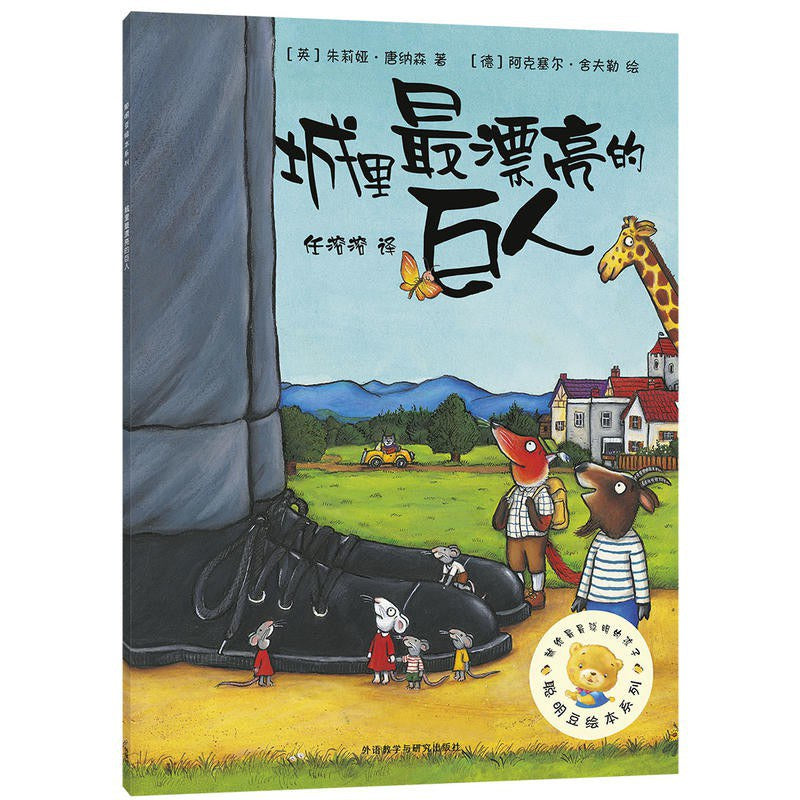
《城里最漂亮的巨人》作者: (英)朱莉亚·唐纳森著 / 阿克塞尔•舍夫勒图
《城里最漂亮的巨人》作者: (英)朱莉亚·唐纳森著 / 阿克塞尔•舍夫勒图
Couldn't load pickup availability
Description
About the Book · · · · · ·
2003 Blue Peter Book Award nominee
The Scruffy Handsome Giant with a Golden Crown
By Mei Zihan
George's "scruffiness" doesn't mean he's dirty; it just means he's not particular about his clothes.
However, there are some things that if you don't care about, others will, and they'll find it unpleasant. You'll know this if you just look at the expressions of the people in the book.
So, George went to buy clothes, dressed himself up handsomely, and became a very handsome man in the city.
But why is it that as soon as he became handsome and incredibly cool, a giraffe, a goat, a mouse, a fox, and a dog, all in need, suddenly appeared? Where were they when the handsome giant wasn't looking good? They're really causing trouble!
Of course, George could have given nothing, because no one asked him for anything. But he still took off his tie, then his belt. Without his belt, even his trousers fell down, leaving him in flowery shorts. This guy has a sense of humor; his shorts are flowery!
We should remember the song he sang: "My tie became a scarf for the shivering giraffe, my shirt became a sail for the goat's boat, my shoes became a house for the mouse family, my socks became a sleeping bag for the fox, but look at me—I'm still the handsomest giant in town." He later hopped on one foot, still singing like this! He truly wants to help people, and that's how he finds joy. If a person truly wants to help others, then that joy might be irrepressible.
We should understand George's sadness when he eventually had to hop on one foot in flowery shorts, because walking through the streets in flowery shorts is not only uncivilized but also genuinely cold.
George's striped tie became a scarf for the giraffe, his shirt became a sail for the goat's boat, his shoes became a house for the mouse family, his socks became a sleeping bag for the fox, and his belt laid on the muddy ground made an excellent little path. — The author's imagination is so fitting! Fitting for the characteristics of the animals, fitting for the characteristics of the objects. Because it's fitting, it's real! It makes us see no "nonsense" that we sometimes encounter in some fairy tales. When writing fairy tales, it's very important that every detail is fitting. Because fairy tales can easily be confused with nonsense.
The scruffiest giant, the handsomest giant, the kindest giant; because George is the kindest giant, he ultimately gives away all his handsomeness to others, and so he ultimately becomes the scruffiest giant again, with a pair of old brown sandals and a patched old robe. But this scruffiest giant wears a golden crown!
A person wearing a golden crown, even if only in old sandals and an old robe, is still handsome!
"The Smartest Giant in Town" — Interwoven Visual Delights
(By Li Yinyin, PhD in Children's Literature, National Taitung University, Taiwan)
Open the front and back covers, and this spread is a complete story. Characters break free from the book's chapter snippets, creating foreshadowing through their interactions and seeming to extend the storyline. Can you see the relationships between these characters? Look closely; the animals' gazes are like arrows, focusing on the giant in the middle. Interestingly, those elongated feet indeed highlight the giant's size and mystery; and the angry gaze and trembling whiskers of the rabbit trapped in the clothes provide a different interpretation of "giant."
Axel Scheffler habitually uses a circular projection as a background on the endpapers to highlight the protagonist's story. In this image, the giant can be seen walking into the story in shabby clothes, hunched over, his lips tightly sealed without a smile, and looking dispirited.
Around the 19th century, giants and fairy tales appeared in children's literature. Have you noticed? Axel connects these stories, reinterpreting them through illustrations: first, the giant comes to town and sees the boot-wearing cat by the fountain washing its hands, the little mermaid's father looking at him with disdain, and the dwarves fuming because they can't buy clothes. All of this strengthens George's determination to shed his scruffiness. Then George takes off his beautiful clothes to help the animals—with each item changing its function, George makes new discoveries until he finds himself again—from the endpapers to the last page of the story, George's mouth curves into a crescent moon.
The most brilliant thing about this book is that you can find the little clues and delights Axel has hidden in the illustrations. Have you noticed? On George's way home, he encounters many familiar characters from fairy tales, highlighting his differences and changes: like the little pig rushing along on his own, Jack waiting for the golden egg, and George happily helping others; the Frog Prince in splendid clothes and George singing and hopping as he gives away his shoes and socks; the sheep turning away with the wool and George shivering in the wind; and of course, George, back in his old clothes but already different from before.
In the symphony of illustrations, Axel masterfully combines literary, musical, artistic, and rich humorous qualities. This is a picture book worth savoring repeatedly.
About the Author · · · · · ·
Julia Donaldson
A famous British writer. Before officially entering the field of children's book creation, Julia spent a long time writing songs and scripts for children's television programs, which is why her words are catchy and loved by children. To date, Julia has created over 40 children's books and plays. In addition to her dedicated children's book writing, Julia also frequently visits schools and libraries to tell stories or perform her works for young readers.
Currently, Julia lives in Glasgow, Scotland, with her husband and three sons.
Axel Scheffler
Born in Hamburg, Germany in 1957, he is a world-renowned illustrator. His illustrations are both elegant and humorous, with lively and flexible visual language full of implied humor. Critics describe Axel's illustrations as a performance, where literary, artistic, musical, and rich humorous qualities harmoniously dance under his brush. Axel currently resides in London, UK.
Ren Rongrong
A renowned Chinese translator and children's literature writer. Ren Rongrong is proficient in four foreign languages: English, Russian, Italian, and Japanese. He has translated many famous foreign children's literary works, such as Andersen's Fairy Tales, Grimm's Fairy Tales, the Italian fairy tale "Pinocchio," the British fairy tale "Peter Pan," and the Swedish fairy tale "Pippi Longstocking." He has also written witty and humorous stories like "Gudong Is Coming" and "No-Head and Unhappy."
Ren Rongrong has deep expertise in translating children's poetry and rhyming stories. His translations not only preserve the content, structure, and artistic conception of the original text but also strive to align with the characteristics and comprehension level of Chinese children. The translations in this picture book series maintain Ren Rongrong's consistent writing style, being catchy and rich in flavor, making them readily accepted by young readers.
